
 Batoi Corporate Office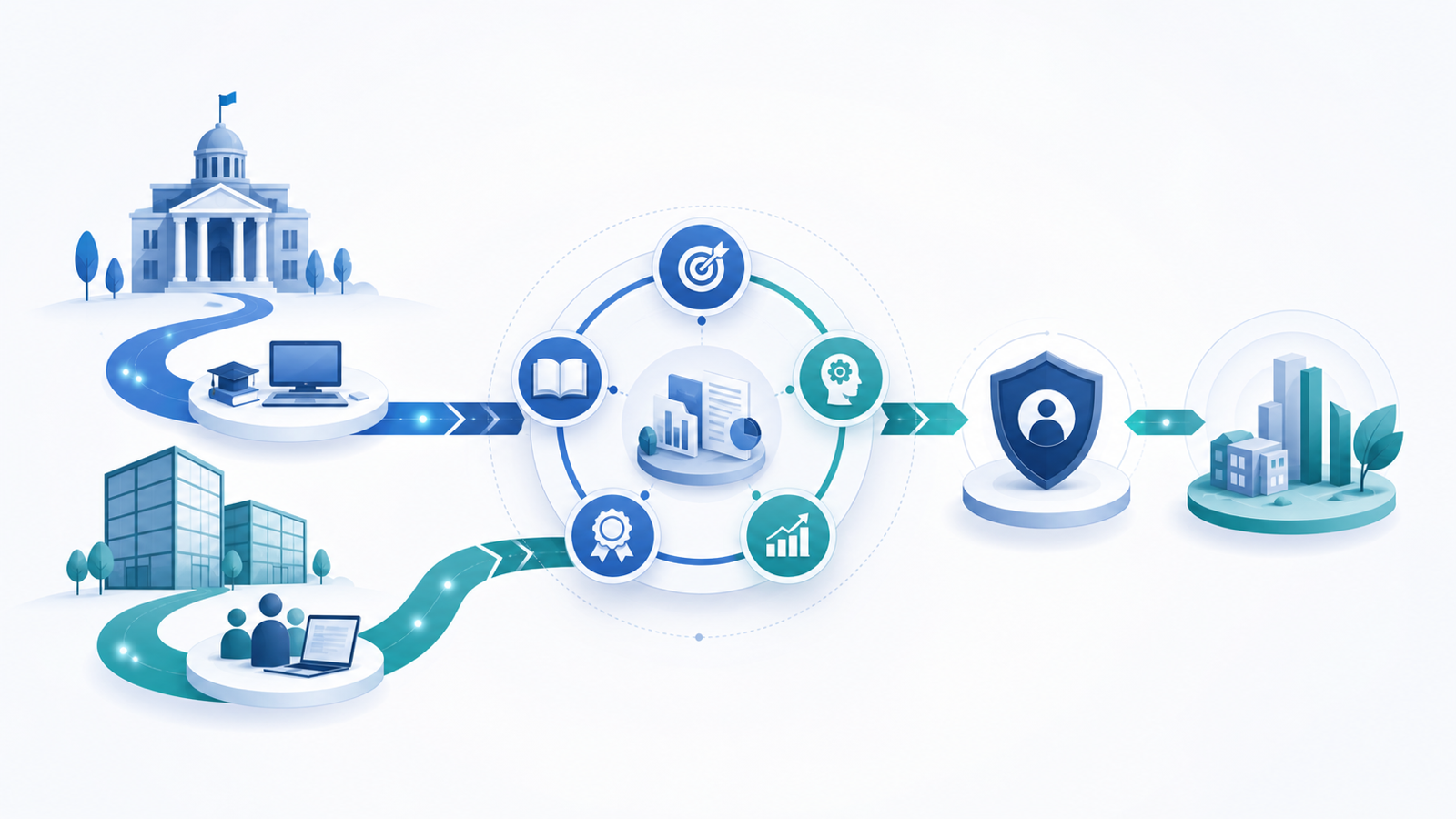
Digital transformation succeeds when people can make better decisions, perform new work responsibly, and show evidence of what they have learned. Technology matters, but installing another tool or completing another course does not by itself create capability.
Batoi Learn is designed for the space between understanding a method and applying it to accountable work. It gives academic programs and corporate teams guided Labs, private practice, transparent assessment, reflection, and a reviewed path toward application inside Batoi Platform.
This makes Learn useful for two different environments. Universities and professional programs can connect practice to curriculum outcomes. Organizations can connect development tailored to each role with transformation priorities. In both cases, the aim is the same: replace activity counts with work and evidence that reviewers can assess.
What Makes Digital Transformation Sensible?
A sensible transformation program starts with a real outcome and introduces change in controlled steps. It does not begin with a technology trend and search for somewhere to deploy it.
Four principles keep capability development connected to responsible change:
- Outcome before tool: define what a learner, employee, team, or institution should be able to do better.
- Practice before operational use: use safely limited scenarios and safe data before applying a new method to real work.
- Evidence before confidence: review decisions, artifacts, assessment criteria, and reflection rather than relying only on attendance or completion.
- Human review before application: treat the result of a Lab as a proposal for accountable review, not an automatic production change.
How Academic Environments Can Use Batoi Learn
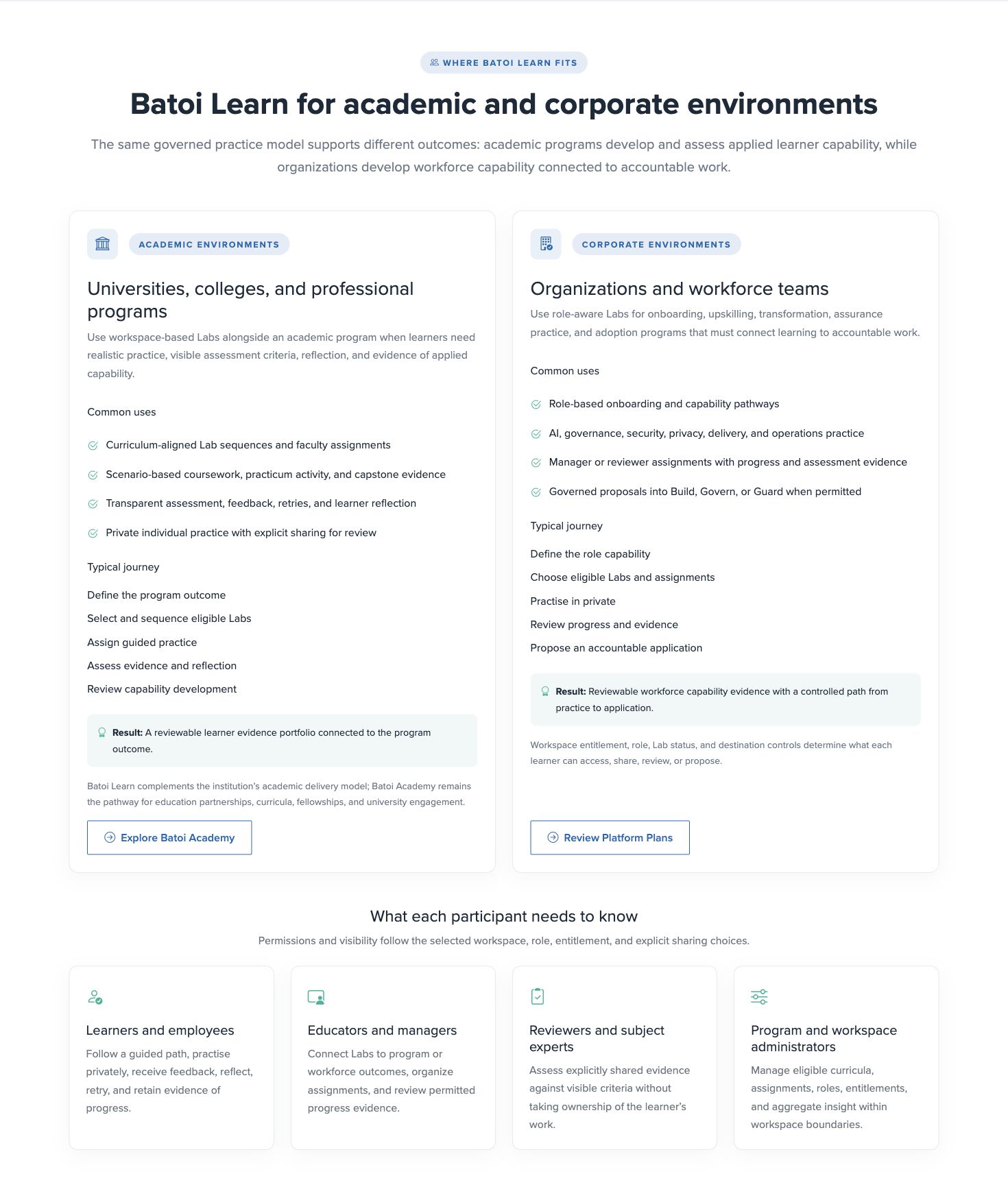
In a university, college, or professional program, Learn can sit alongside the institution's existing academic delivery model. The institution continues to own curriculum, teaching, grading, learner records, awards, and academic policy. Learn provides the guided practice layer when learners need to work through realistic scenarios and produce evidence of applied judgment.
A faculty team could use it to:
- sequence selected Labs around defined course or program outcomes;
- assign scenario-based exercises as coursework, practical assignments, or capstone activity;
- make assessment criteria visible before a learner submits work;
- support feedback, retries, and reflection instead of treating the first answer as final;
- retain private individual practice until the learner explicitly shares evidence for review; and
- review an evidence portfolio that shows development over time.
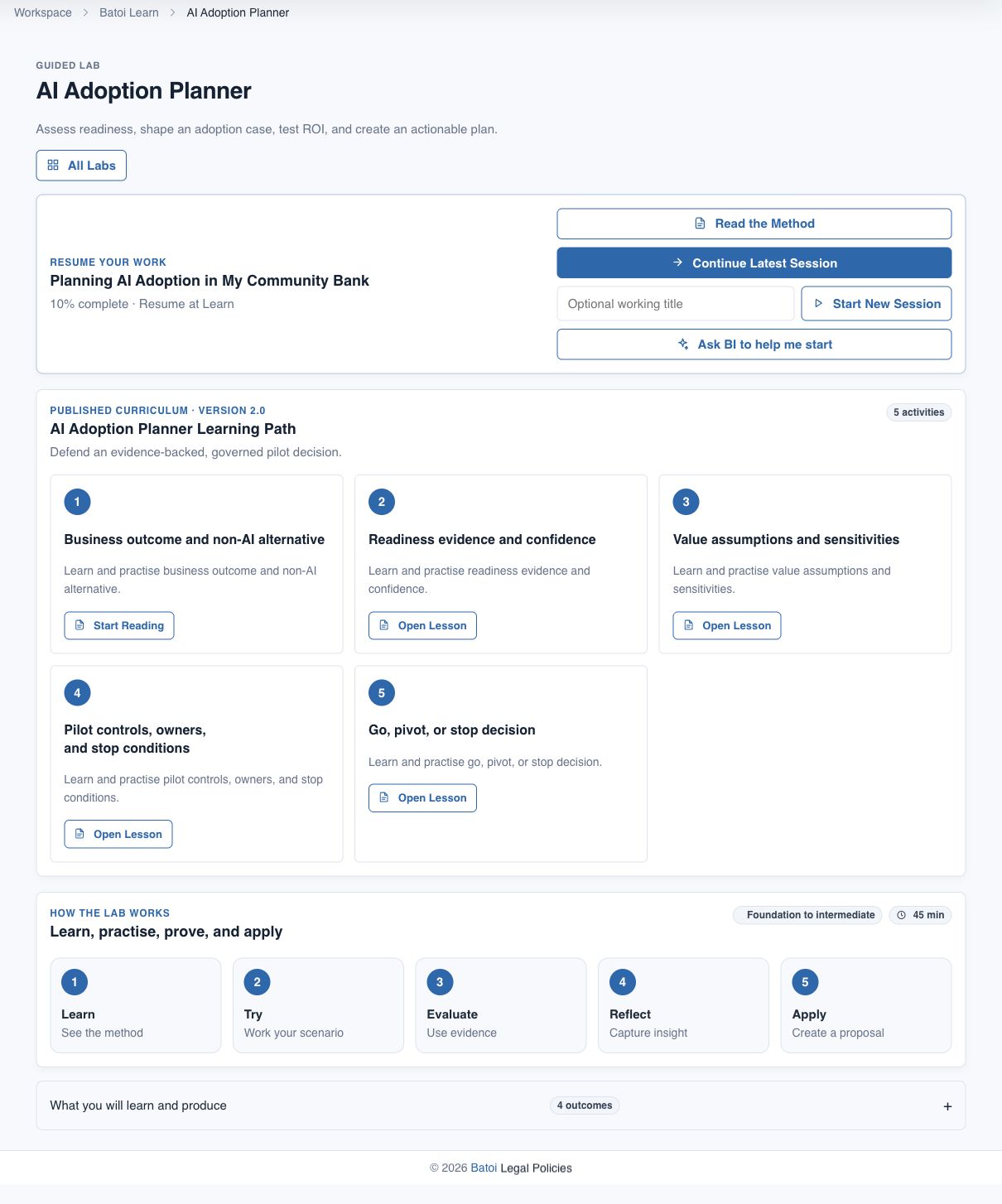
For example, an AI-related program might combine the AI Adoption Planner, AI Governance & Compliance Lab, Applied ML Lab, and AI Response Lab. The sequence can move from adoption reasoning to governance, experimentation, and response evaluation without confusing tool fluency with production authority.
How Corporate Environments Can Use Batoi Learn
Corporate transformation often stalls after awareness sessions because employees understand the language of change but have not practised the decisions their roles require. Learn can help bridge that gap through learning paths tailored to each role and tied to a clearly defined organizational outcome.
An organization could use Learn for:
- role-based onboarding for new responsibilities or operating models;
- upskilling in AI, governance, security, privacy, delivery, cloud, and operations;
- manager or reviewer assignments with visible progress and assessment evidence;
- transformation pilots that test capability before wider process change;
- assurance rehearsals using safe scenarios before a real review or release; and
- results submitted to Batoi Build, Govern, or Guard for review when workspace access and permission allow.
A delivery team, for example, might use Batoi Build Fundamentals, the Governed Agentic Delivery Lab, Security Assurance Lab, and Operations Readiness Lab. The resulting evidence can help a manager identify whether the team is ready for a controlled pilot, where review is still needed, and which safeguards must remain in place.
What Batoi Learn Is, and What It Is Not
Clear boundaries matter when selecting a learning or transformation platform.
- It is guided practice: Labs provide a defined outcome, activity, evidence, feedback, reflection, and reviewed next step.
- It is workspace-scoped: availability and visibility depend on the selected workspace, access level, role, Lab availability, and sharing choices.
- It is evidence-oriented: completion matters less than whether the learner can explain decisions and improve the work.
- It is not automatic production deployment: a completed result must still be submitted for review and remains subject to destination controls.
- It is not a replacement for institutional ownership: academic and corporate leaders still define outcomes, policy, accountability, and final decisions.
A Six-Step Adoption Plan
- Choose one outcome. Define the academic capability or role capability in observable terms. Avoid beginning with a broad instruction to “learn AI” or “become digital.”
- Select a small, clearly defined group. Start with one course, team, role, or transformation workstream that has a clear sponsor and reviewer.
- Choose the minimum Lab sequence. Use only the Labs needed to support the outcome. Confirm workspace access, Lab availability, roles, and review responsibilities before launch.
- Define the evidence and assessment criteria. Tell participants what artifact, reasoning, reflection, and quality criteria will be reviewed.
- Run practice and review. Keep work private by default, share deliberately, give feedback, and allow a retry where improvement is part of the objective.
- Decide what follows. Review cohort evidence before expanding the program or approving an operational proposal. Record remaining gaps and safeguards.
Measure Capability, Not Just Participation
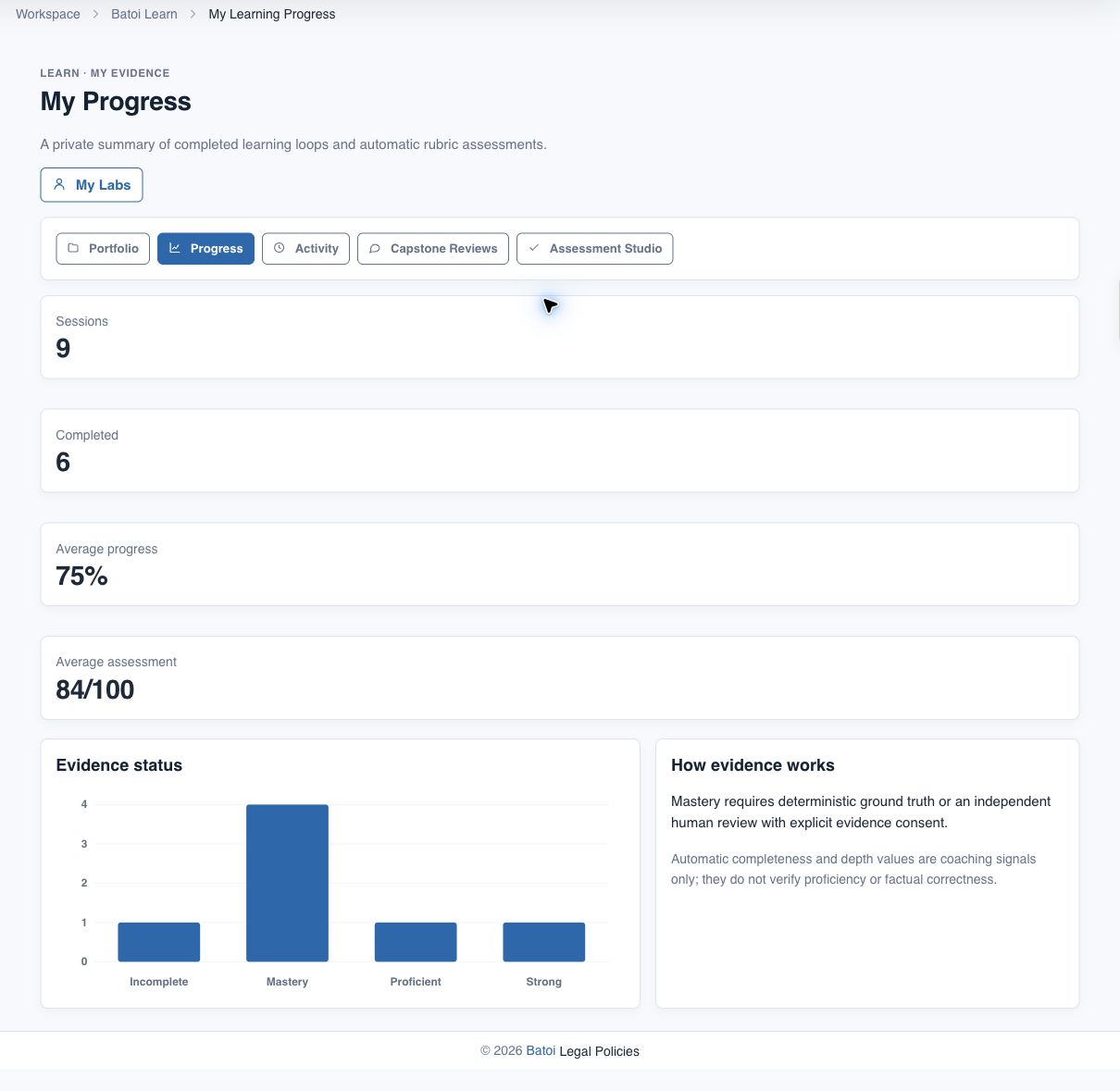
Course registrations, attendance, and completion rates are useful operating measures, but they do not prove transformation. A stronger evaluation includes:
- the percentage of participants who meet the published assessment criteria;
- the quality improvement between an initial attempt and a reviewed retry;
- the completeness and clarity of evidence submitted for review;
- the time reviewers spend identifying common capability gaps;
- the proportion of operational proposals approved, revised, or declined after review; and
- whether approved application produces the intended academic or organizational outcome without weakening governance.
These measures make the program useful even when the correct decision is not to proceed. Discovering through guided practice that a team needs more preparation is a valuable transformation result.
Questions to Ask Before Starting
- What decision or capability should change after the program?
- Who owns the academic or business outcome?
- Which Labs are available to the intended participants?
- Who will review evidence, and against which criteria?
- What information must remain private or use synthetic data?
- What can a successful participant propose, and who can approve it?
- How will the institution or organization decide whether to expand, revise, or stop the pilot?
From Learning Activity to Accountable Progress
Batoi Learn is most useful when leaders resist the urge to equate more training with more transformation. The practical opportunity is to create a visible bridge between instruction, realistic practice, assessment, reflection, and a controlled next decision.
Academic programs can use that bridge to develop applied learner capability without surrendering academic ownership. Corporate teams can use it to prepare people for new responsibilities without turning practice into unreviewed operational change. Both gain a clearer answer to the question that matters: can people use what they learned responsibly, and is there evidence to support the next step?