
 Batoi Corporate Office
Real estate is a relationship business. Listings change. Markets fluctuate. Transactions close. But what remains constant is the importance of managing people well - buyers, sellers, tenants, investors, and referral partners.
Many real estate firms invest in listing platforms, marketing tools, and transaction software. These are necessary and often highly specialised. Yet even with these systems in place, operational friction frequently appears elsewhere.
Inquiries are missed. Follow-ups are delayed. Documents are scattered across email threads. Client context lives partly in memory and partly in spreadsheets. Billing and commission tracking happen separately from communication.
The challenge is rarely the property listing system itself. It is the coordination around it. This guide outlines how small and growing real estate firms can structure client management without introducing complex enterprise systems.
The Client Lifecycle in Real Estate
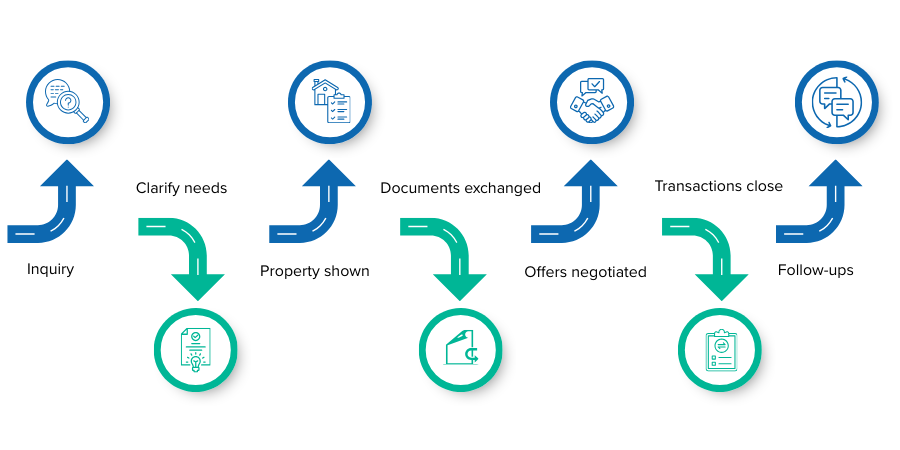
Every real estate engagement follows a recognisable pattern.
A prospective client makes an inquiry. Conversations clarify needs. Properties are shown. Documents are exchanged. Offers are negotiated. Transactions close. Follow-ups continue long after the deal. The listing platform handles property visibility. Transaction systems manage formal documentation. But much of the relationship work happens outside those tools.
When client interaction, delivery milestones, and billing exist in separate silos, clarity suffers. A structured approach aligns these elements without replacing specialised platforms.
Centralising Client Visibility
The first step is visibility. For each client - whether buyer, seller, landlord, or investor - a firm should be able to answer quickly:
- Who is this client?
- What stage are they in?
- What properties are involved?
- What is the next action?
- Who owns the relationship?
If this information requires checking multiple tools, searching email threads, or asking colleagues, operational risk increases.
A simple, shared client record that captures contact details, engagement status, notes, and next steps reduces dependency on memory. It ensures that relationships do not stall when someone is unavailable. Visibility is not about surveillance. It is about reliability.
Managing Inquiries Without Losing Momentum
Real estate inquiries arrive through many channels:
- Property portals
- Website forms
- Social media
- Referrals
- Direct phone calls
Speed matters. Prospects often contact multiple agents simultaneously. If responses are delayed or unstructured, opportunities disappear quietly.
A structured inquiry capture process ensures that:
- Every inquiry is recorded
- Ownership is assigned
- Follow-up timing is visible
This does not require an enterprise CRM with predictive scoring. It requires discipline in tracking who has reached out and what needs to happen next.
When inquiry tracking is visible and shared, response times improve naturally.
Organising Property and Client Context
Listings may be managed within MLS or property platforms. However, context around the client’s intent - preferences, concerns, financial readiness, timeline - often lives outside those systems.
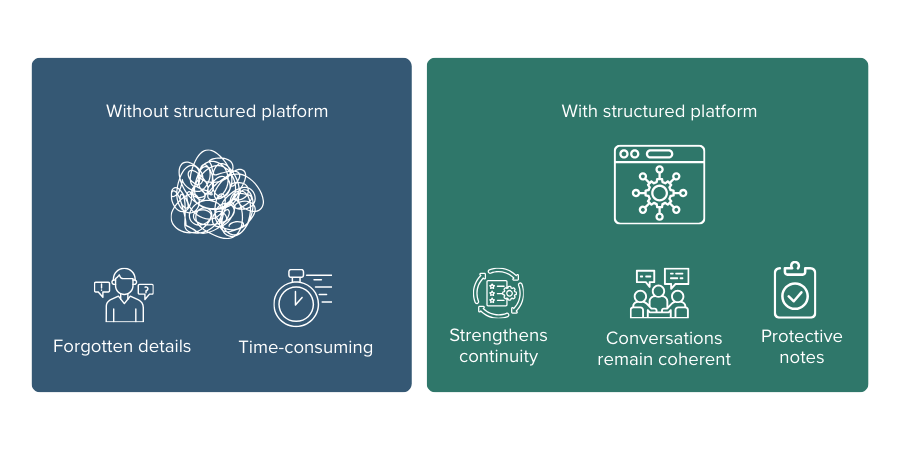
Associating client notes, property discussions, and document exchanges in one place strengthens continuity. It ensures that conversations remain coherent even when multiple team members are involved.
Without structure, important details are easily forgotten. A client’s preferred neighbourhood, budget flexibility, or urgency level may exist only in past messages. Retrieving this information later becomes time-consuming. Structured notes are not bureaucratic. They are protective.
Coordinating Documents and Transactions
Transactions involve contracts, disclosures, inspection reports, and financial documents. While transaction platforms handle formal documentation, coordination around them often remains manual.
Questions to consider:
- Is there a clear record of what has been sent?
- Can the team see which documents are pending?
- Are client communications tied to transaction milestones?
When document coordination is scattered across inboxes, risk increases. Aligning documents and notes with the relevant client and property creates clarity.
This does not replace transaction software. It complements it by providing relational context.
Billing and Commission Tracking
Real estate firms may manage commissions, referral fees, and related invoices separately from client interaction.
Separating financial tracking from client visibility can create blind spots. When commission status is unclear, internal coordination suffers.
A lightweight operational layer that aligns billing context with client records improves discipline. It ensures that financial outcomes are not disconnected from relationship management.
Using Links and QR Codes Thoughtfully
Real estate is highly visual and location-based. QR codes can simplify property access and client engagement.
Examples include:
- QR codes on property signage linking to listing details
- QR codes on brochures linking to virtual tours
- Links for booking property viewings
- Contact-save QR codes for agents
The key is ensuring that these links connect back into a structured system rather than scattered landing pages.
When inquiries generated from QR codes flow directly into a shared client management view, follow-up becomes easier and faster.
Avoiding Over-Engineering
Real estate firms sometimes overcompensate for operational gaps by adopting complex CRM systems designed for large brokerages. These systems can be powerful, but they also demand consistent data entry and maintenance.
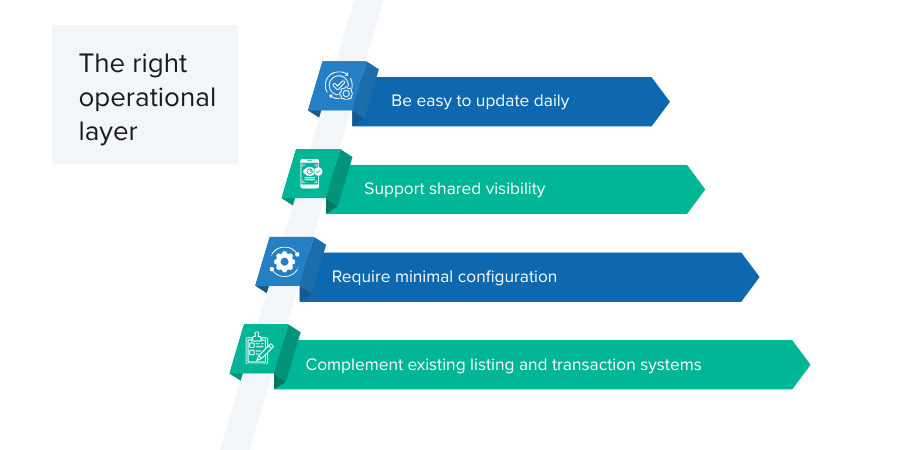
If a system feels heavier than the business itself, adoption declines. Small and mid-sized firms benefit more from structured simplicity than from feature abundance. The right operational layer should:
- Be easy to update daily
- Support shared visibility
- Require minimal configuration
- Complement existing listing and transaction systems
Complexity does not guarantee control. Clarity does.
A Practical Internal Review
A real estate firm can assess its operational health with a few straightforward questions:
- Can we see all active buyers and sellers clearly?
- Does each client have a defined next step?
- Are inquiries captured consistently?
- Is transaction-related communication visible to the team?
- Can a new team member understand our process quickly?
If answering these questions requires digging through emails or multiple tools, refinement is needed.
Structured Simplicity as a Competitive Edge
In real estate, responsiveness and reliability build trust. Trust builds referrals. Referrals build growth.
Operational clarity supports that cycle. When client relationships, inquiries, property context, and billing are aligned within a coherent structure, the firm operates more confidently. Staff spend less time reconstructing information and more time serving clients.
Small and growing real estate firms do not need enterprise complexity to achieve this. They need disciplined coordination.
An operational guide for client management is not about adding tools. It is about aligning what already exists into a clearer flow. That alignment reduces friction. Reduced friction improves service. Improved service strengthens reputation. And in real estate, reputation is everything.