
 Batoi Corporate Office
Dental clinics operate in a structured environment. Clinical systems, patient records, compliance standards, and regulatory requirements are already well defined. Most clinics today use practice management software or EHR systems for clinical workflows.
Yet despite this structure, many dental practices experience operational friction - not inside the clinical room, but at the front desk. Appointments are confirmed manually. Follow-ups depend on reminders in someone’s head. Invoices and payments are tracked separately. Website updates lag behind changes in services. Patient communication becomes reactive instead of structured.
The purpose of this checklist is not to replace clinical systems. It is to strengthen the operational layer around patient interaction and coordination. A well-run dental clinic is built on consistency. Patients expect clarity, responsiveness, and professionalism. Small operational gaps can quietly erode trust. Below is a practical checklist for dental clinics to assess and strengthen their daily operations.
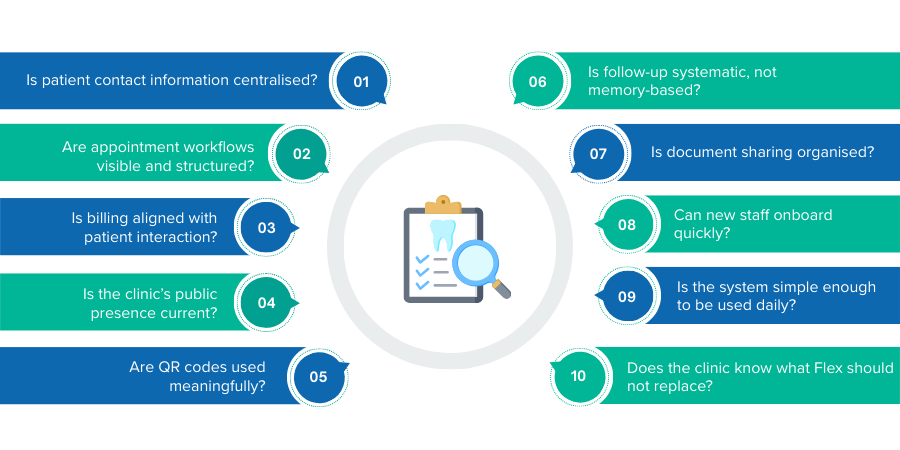
1. Is patient contact information centralised?
Every clinic maintains patient records in clinical systems. But outside the medical file, how accessible is patient contact information for operational use?
A clinic should be able to answer:
- Can the front desk quickly access phone and email details?
- Are contact updates captured consistently?
- Is the communication history visible to more than one staff member?
If patient contact details live partly in messaging apps, partly in personal notes, and partly in clinical records, coordination becomes fragile. A centralised operational contact view reduces dependency on individuals and prevents missed follow-ups.
2. Are appointment workflows visible and structured?
Appointments are the backbone of a dental practice.
Consider:
- Is there clarity on upcoming appointments for the week?
- Are cancellations tracked systematically?
- Is there a simple way to handle rescheduling requests?
While clinical software handles scheduling, the broader workflow - confirmations, reminders, and inquiries - should be visible and manageable without confusion. Patients often request appointments online or through informal channels. These requests should feed into a structured process, not sit unattended in email threads.
3. Is billing aligned with patient interaction?
Billing in dental clinics can become complex, especially where insurance is involved. However, even in simple cases, operational friction can arise.
Ask:
- Can invoices be generated and shared quickly?
- Are payment links easy to send?
- Is payment status clearly visible to staff?
When billing and patient communication exist in separate silos, misunderstandings increase. Aligning billing visibility with patient interaction reduces disputes and speeds up collections.
4. Is the clinic’s public presence current?
A surprising number of clinics operate with outdated websites.
Check:
- Are the listed services accurate?
- Are clinic hours current?
- Are emergency contact details easy to find?
- Can new services or promotions be published quickly?
Patients often research before calling. A static or outdated online presence undermines confidence. Clinics should have a simple way to update services, add announcements, or share seasonal campaigns without relying on external developers.
5. Are QR codes used meaningfully?
QR codes can simplify patient interaction when used thoughtfully. They can support:
- Quick access to booking pages
- Digital payment links
- Feedback forms
- Clinic contact saving
- Patient information updates
However, QR codes should be intentional. Each one must have a clear purpose and route into a coherent system. Scattered QR links generated by multiple tools can confuse.
When QR codes connect to a central operational layer, updates become easier, and management becomes simpler.
6. Is follow-up systematic, not memory-based?
Follow-up is critical in dental care.
Whether it is:
- Treatment plan acceptance
- Recall appointments
- Post-procedure check-ins
- Pending payment reminders
If follow-up depends primarily on personal memory, inconsistency will follow. A visible system for recording next steps reduces missed opportunities and enhances patient trust.
7. Is document sharing organised?
Dental clinics frequently share:
- Treatment plans
- Invoices
- Payment confirmations
- Consent forms
If document sharing relies on ad-hoc attachments in emails or messaging apps, retrieval becomes difficult. Organised document tracking - even at a basic operational level - improves clarity and reduces the number of repeated patient requests.
8. Can new staff onboard quickly?
Operational clarity becomes most visible during staff transitions.
Ask:
- Can a new receptionist understand workflows quickly?
- Is there a clear place to manage patient interactions?
- Are tools easy to explain and access?
If onboarding requires explaining multiple disconnected tools, simplification may be necessary.
9. Is the system simple enough to be used daily?
Complex systems often fail because they are not used consistently. An operational layer for a dental clinic should:
- Be easy to access
- Require minimal configuration
- Support daily routines naturally
- Avoid unnecessary feature depth
Simplicity encourages discipline.
10. Does the clinic know what Flex should not replace?
It is equally important to define boundaries. An operational layer should not attempt to replace:
- Clinical record systems
- Diagnostic tools
- Insurance claim platforms
- Regulated compliance workflows
The goal is not system replacement. It is operational cohesion.
Bringing It Together
A dental clinic’s reputation rests on professionalism and consistency. Clinical excellence must be matched by operational clarity. When patient contact management, appointments, billing, publishing, and communication are aligned within a simple operational structure, friction decreases. Staff feel less overwhelmed. Patients experience smoother interaction.
The objective is not transformation. It is refinement. Small improvements in coordination compound over time. They reduce errors. They prevent missed follow-ups. They create confidence.
Dental clinics do not need enterprise-level systems for front-office operations. They need a structured, visible way to manage daily interaction. When that structure is in place, the clinic can focus on what matters most - patient care.