
 Batoi Corporate Office
For small accounting firms, client relationships are the foundation of the business. Technical competence is expected. Trust, responsiveness, and reliability are what differentiate one firm from another.
Yet many small firms manage client engagements with a surprising amount of operational friction. Emails contain key instructions. Deadlines are tracked in spreadsheets. Documents are stored across shared drives. Billing is handled in separate systems. Follow-ups depend on memory. As the number of clients grows, so does the complexity of coordination.
The challenge is rarely accounting knowledge. It is engagement management. Client engagement, in its simplest form, involves three layers: relationship, delivery, and billing. When these layers operate independently, strain appears. When they are aligned, clarity improves.
Let’s examine how small accounting firms can structure engagement management without introducing heavy enterprise systems.
The Engagement Lifecycle
Every accounting engagement follows a predictable rhythm. A prospective client makes contact. Initial discussions clarify the scope. Documents are requested. Work is performed. Deliverables are shared. Invoices are sent. Ongoing advisory conversations continue.
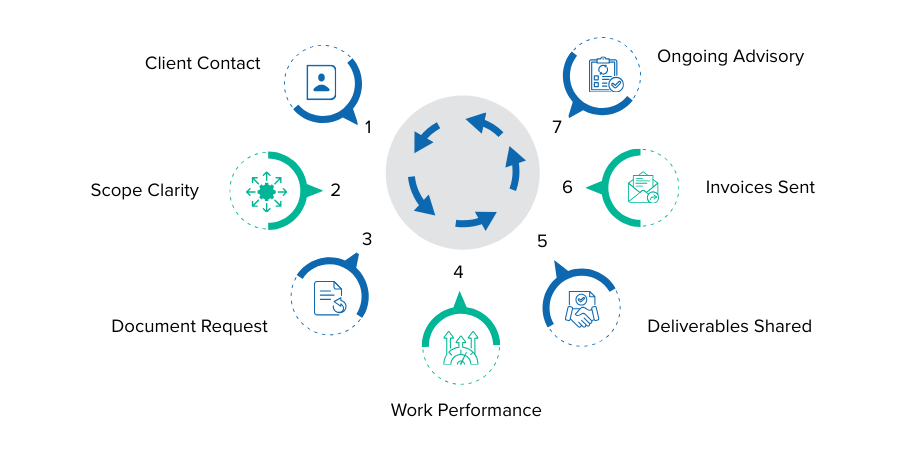
None of this is complicated. What complicates it is fragmentation. When initial conversations happen in one place, document requests in another, delivery notes in a third, and invoices in a fourth, visibility suffers. No single view shows the full context of the engagement.
Over time, this creates subtle inefficiencies. A team member may not know whether documents were received. A follow-up might be delayed. Billing status might not be clear at a glance. These small gaps compound.
Client Visibility Without CRM Overload
Small firms often hesitate to adopt CRM systems because they associate them with sales pipelines and complex automation. But accounting engagements are not about aggressive sales. They are about structured relationships.
A practical approach is to maintain a simple, visible structure around each client:
- Clear client contact details
- Engagement type (tax filing, audit, advisory, bookkeeping)
- Current status
- Next action
- Relevant notes
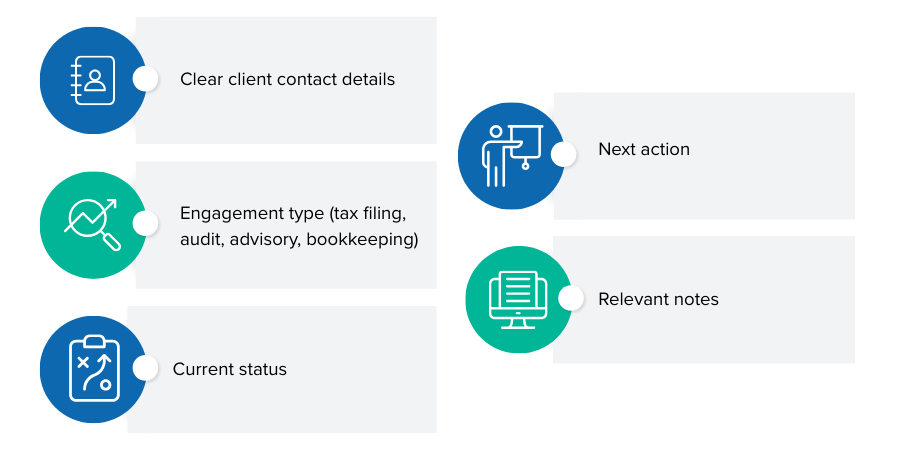
It does not require advanced scoring or forecasting. It requires clarity. When each engagement has a visible status and next step, internal communication improves. Even in a small firm, shared visibility reduces dependency on a single individual’s memory.
Document Coordination
Accounting firms live in documents. Financial statements, tax returns, supporting documents, and compliance records - all must be handled carefully. Yet document coordination is often one of the most chaotic parts of small firm operations.
Questions to consider:
- Is there a consistent method for requesting documents?
- Can the team see which documents have been received?
- Is there a clear place to store engagement-related notes?
When document requests are scattered across email threads, tracking becomes difficult. Clients resend the same files. Staff search through inboxes. Confusion increases.
A structured engagement layer should allow documents and notes to be associated directly with the relevant client. It reduces friction and improves accountability.
Managing Deadlines and Follow-Ups
Deadlines are non-negotiable in accounting. Filing dates, compliance windows, and advisory milestones require precision.
However, missed follow-ups are rarely caused by a lack of awareness. A lack of visibility causes them. If follow-ups depend solely on calendar reminders or individual to-do lists, the system is fragile. A simple, centralised way to record next actions for each client strengthens discipline.
The aim is not to build complex workflow engines. It is to ensure that:
- Every engagement has a next step.
- That step is visible.
- Ownership is clear.
Even a basic structure prevents oversight.
Billing Alignment
In many small firms, billing exists in isolation from engagement tracking. Work is delivered, but invoicing happens later. Payment status may not be immediately visible to those managing the client relationship.
This separation introduces tension. It can also delay revenue collection. Aligning billing visibility with engagement context improves financial discipline. When a client’s status and payment position are visible together, follow-ups become more natural. Transparency benefits both the firm and the client.
Publishing Services Clearly
Small accounting firms often underestimate the importance of their public presence. Is it clear what services are offered? Are advisory packages described simply? Can prospective clients request consultations easily?
A structured and updatable service presentation reduces back-and-forth communication. Prospective clients arrive better informed. Consultation requests become more focused. Publishing clarity is not marketing excess. It is operational efficiency.
Avoiding Over-Engineering
One of the biggest risks small firms face is overcompensating for disorder with overly complex systems. It is tempting to adopt enterprise-grade software with dozens of features. But if the team does not consistently use it, complexity becomes counterproductive.
The right structure should feel natural to maintain on a daily basis. It should not require hours of configuration. It should not overwhelm staff with unnecessary fields or automation rules. Simplicity drives consistency. Consistency drives reliability.
Defining Boundaries
It is equally important to clarify what should not be replaced.
Core accounting platforms, tax preparation software, audit tools, and compliance systems are specialised for good reason. An engagement management layer should complement these tools, not attempt to replace them.
The objective is coordination - not reinvention.
A Practical Internal Checklist
A small accounting firm can assess its engagement management with a few simple questions:
- Can we clearly see all active client engagements?
- Does each engagement have a visible next step?
- Are the documents directly associated with the correct client?
- Is billing status easy to verify?
- Can a new team member understand the structure quickly?
If any of these questions is unclear, operational refinement is needed.
The Value of Structured Simplicity
Accounting is built on precision. Engagement management should reflect that same discipline. When client relationships, delivery progress, and billing are aligned within a coherent structure, firms operate with greater confidence. Staff spend less time searching for information. Clients receive clearer communication. Revenue cycles tighten.
Small accounting firms do not need complexity to achieve this. They need visibility. Structured simplicity reduces friction without adding weight. It allows professionals to focus on analysis, advisory, and compliance - not on chasing documents or reconstructing conversations.
Managing client engagements well is not about adopting more software. It is about creating clarity in how relationships are tracked and how work is coordinated. That clarity, maintained consistently, becomes a competitive advantage.