
 Batoi Corporate Office
Small businesses rarely struggle because they lack software. More often, they struggle because they have too much of it.
Over time, tools accumulate. A booking app is added because appointments are hard to track. A payment tool is introduced because invoicing is messy. A spreadsheet is created because leads need structure. A website builder is used because visibility matters. None of these decisions is wrong. Each solves a problem at the moment it appears.
The issue begins when these tools never reconnect.
What starts as practical problem-solving slowly becomes operational fragmentation. Information lives in different systems. Conversations are scattered. Billing is tracked in one place, delivery in another, and customer history in yet another. The team adapts to it. They remember where things are. They work around it.
But the friction remains.
Tool sprawl is not dramatic. It doesn’t break the business overnight. Instead, it quietly consumes attention. A message is missed because it was in the wrong channel. A payment is delayed because no one checked the right dashboard. A follow-up slips through because it lives in someone’s memory rather than in a visible system.
As teams grow from two people to eight, or from eight to fifteen, that quiet friction becomes visible strain.
The reasons this happens are understandable. Small businesses adopt tools reactively. They rarely sit down to design an operational architecture. Free or low-cost tools are easy to start with, and growth happens gradually. What worked for three people feels workable for six, until suddenly it doesn’t.
There is also a cultural element. Founders focus on sales. Teams focus on delivery. Operational structure becomes secondary. No one owns the question, “Is this still simple?”
The cost of tool sprawl is not just subscription fees. It is cognitive load. It is context switching. It is the subtle fatigue of not knowing where the latest information lives. It is time spent reconciling data instead of serving customers.
Customers feel it too. Responses take longer. Instructions vary. Links change. Information feels fragmented.
Reducing tool sprawl does not mean eliminating technology. It means aligning technology around core operational flows.
Every small business, regardless of industry, revolves around a few fundamental movements. Customers reach out. Work is delivered. Payments are collected. Information is shared. If these movements live in disconnected systems, friction multiplies.
A better approach is to consolidate around operations rather than features.
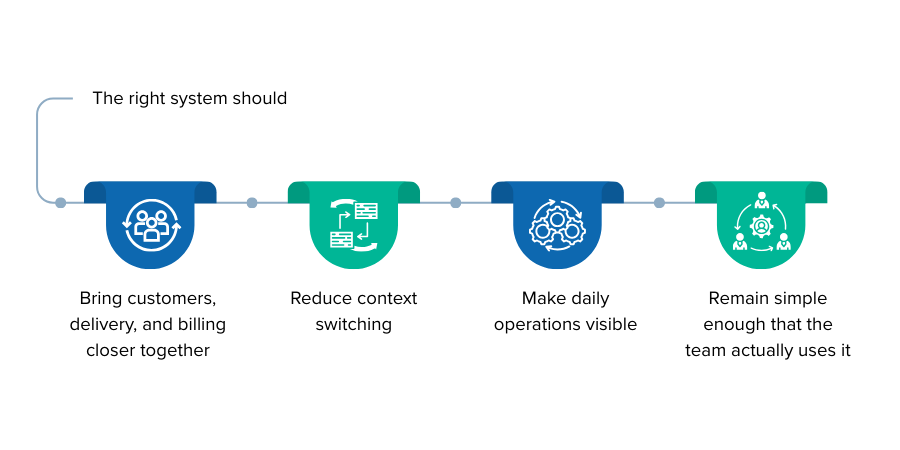
Instead of asking whether a tool has advanced automation or dozens of integrations, it is more useful to ask whether it reduces daily friction. Does it bring customer interaction, delivery tracking, billing, and public presence closer together? Does it reduce the number of places the team must check each day? Does it make visibility natural instead of forced?
Simplicity is not the absence of capability. It is the presence of coherence.
One of the most overlooked areas where sprawl appears is in the connection between the physical and digital world. A restaurant prints static menus while maintaining separate payment links. A clinic shares different URLs for bookings and forms. A real estate agent distributes property links from one tool while managing inquiries in another. These are not failures of effort; they are symptoms of fragmentation.
When links, QR codes, bookings, forms, and payments connect back to a single operational layer, coordination improves. The goal is not novelty. It is cohesion.
It is equally important to recognise what should not be consolidated. Core accounting systems, regulatory platforms, clinical records, or trading systems often require specialised depth. Replacing them may introduce more risk than clarity. The objective is not to dismantle every specialised tool, but to create a stable surface around customer interaction and daily coordination.
How can a small business begin to simplify?
Start by mapping what already exists. List the tools currently in use. Identify where customer data lives. Identify where billing is tracked. Notice where duplication occurs. Often, the biggest gains come not from adding something new, but from aligning what is already there.
Consolidate customer management first. Then ensure that invoicing and payment tracking are visible. Align public-facing links and QR codes so they feed back into the same structure. As these pieces begin to connect, operational clarity improves.
Signs that simplification is needed are usually subtle. If it takes effort to answer a simple question about a customer’s status, fragmentation exists. If onboarding a new team member requires explaining five different systems, complexity has crept in. If follow-ups depend on personal memory rather than shared visibility, the system is fragile.
Small businesses succeed not because they use the most software, but because they use the right structure.
Reducing tool sprawl is not about minimalism. It is about intentional design. It is about ensuring that customers, delivery, billing, and publishing are part of a coherent flow rather than separate islands.
When operations are aligned, teams move faster. Responses become clearer. Growth feels manageable instead of chaotic.
The objective is not to remove tools. It is to remove friction. That is the difference between software usage and operational clarity.