
 Batoi Corporate Office
The Kanban method originated in Japan in the early 1940s, developed by Toyota Industrial Engineer and Businessman Taiichi Ohno. It was created as a simple planning system and workflow management method to maximize efficiency. At the time, Toyota was lagging behind its American automotive competitors in this area. After implementing the Kanban system, Toyota saw vast improvements in efficiency and reduced inventory costs.
Kanban may have started as a lean manufacturing method, but today it's widely used in workplaces worldwide for various projects. David J Anderson first applied the technique to IT and software development in 2004 and to great success. Since then, the Kanban method has increased in popularity and become a key part of agile project management.
What Exactly is Kanban? Kanban Boards and Cards
Let's start with the Kanban board and Kanban cards. Kanban helps you visualize your work, and the Kanban board is the visualization tool. In fact, the term Kanban translates to "visual signal" or "card" in Japanese. So, how do you create a Kanban board?
First, you need to create your cards. These are work items or tasks that you plan to complete. All Kanban cards must be individual tasks and can contain as much or as little information as you want. For example, with a digital Kanban card, you can include links, attachments, descriptions, comments, and so on. You can think of a Kanban card as a Post-it note you plan on sticking on a whiteboard.
Next, you'll want to place your cards on the Kanban board. A basic Kanban board has three columns, "To-do" (activities you haven't yet started), "In-progress" (activities you are currently doing), and "Complete."
However, many situations call for more complex Kanban boards. For example, some people include additional columns to break down core activities that fall into the three basic categories. So, within "To-do," you might have columns for "prioritized" and "unprioritized" work. Under "In-progress", you might have columns for "plan", "develop", "test", and "launch". And under "complete," you might have columns for "pending approval" and "approved."
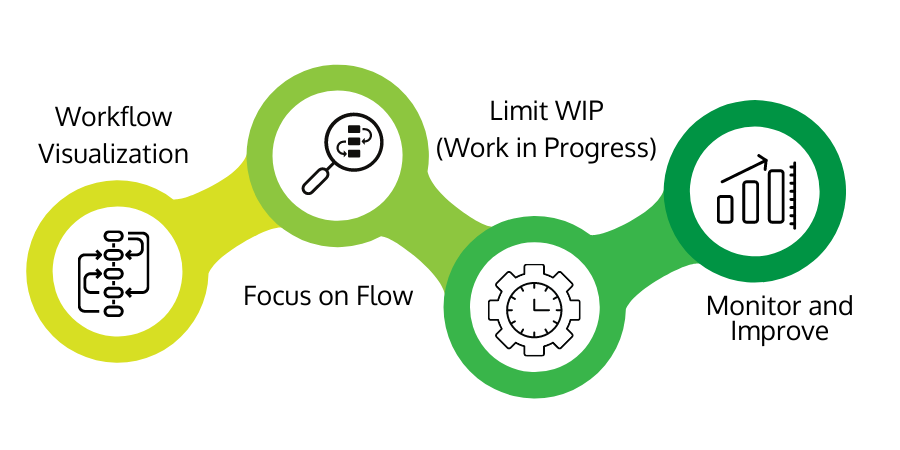
Kanban Principles
Workflow Visualization
The Kanban board functions as a visualization of your current workflow. To make the visualization stronger, you can color code your cards based on different classes of tasks.
Limit WIP (Work in Progress)
A fundamental aspect of Kanban is limiting the amount of work that can exist in each status of the workflow at one time. Limiting the amount of work makes it easier to spot inefficiencies and bottlenecks and improves focus.
Often, we're tempted to start many tasks at once, forcing us to split our focus. The issue with this way of working is that some tasks can become stuck in the "In-progress" section for a long time, especially when problems arise that make those tasks challenging to complete. With WIP limits, the team can rally together to fix one issue and complete one task before moving on to the next or resuming another task.
Remember, multitasking kills productivity.
Focus on Flow
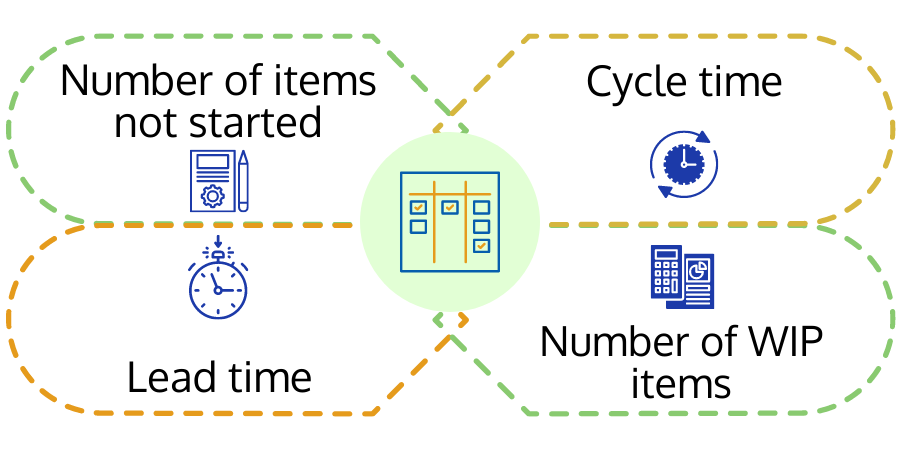
Once you start your Kanban board, you should find that work flows freely throughout the system, rather than stopping and starting. You should also be able to spot any interruptions or bottlenecks to flow much more easily. To manage how effective your Kanban board is at promoting flow, you can track several metrics such as:
- Lead time - How long it takes for a card to move from "To-do" to "Complete".
- The number of items not started - If you have a high number of these items, it could mean you are struggling with your workload and need more help or trim down your To-do column.
- Cycle time - How long it takes for a card to move from "In-progress" to "complete".
- The number of WIP items - Are you staying within your WIP limits or not?
Monitor and Improve (Continuous Improvement)
One fundamental principle of Kanban is to work as you usually do when you start using the method. Kanban promotes small, gradual improvements over time. Essentially, by analyzing and reviewing your Kanban workflow, you should be able to continuously improve your processes and become more efficient over time.
When Can You Use Kanban?
The value of the Kanban method is in clarifying your process, improving your workflow, and working more efficiently. You can use the Kanban method for any project that involves multiple tasks. In fact, the Kanban method can be applied to almost any goal. For example, some people use "personal Kanban" as a way to track their weekly tasks, and these tasks don't have to be connected as they would be in a project.